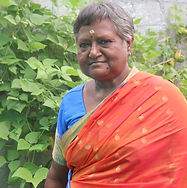
Sakthi Arulanandham
Country:
India
Poem 1:
Poem 2:
Poem 3:

Link:
A Tree Is Not (Just) a Tree
Land Grabbing Bird
Thirumanimutharu River – Salem’s Sorrow
Bio
Sakthi Arulanandham, who works as an electrical household product service technician, is the author of five poetry collections. She is based in Chinna Pagalpatti, a village located at the outskirts of the city of Salem in Tamil Nadu, India. An ecofeminist poet and a short story writer, Sakthi Arulanandham is a recipient of literary awards. Recurring themes in her works include environmental and feminist issues, with a focus on the callous treatment of nature and women. In her capacity as a talented artist, Sakthi Arulanandham also creates unique artwork that complements her poetry.
What are the ecological/ social crises within your region?
Sakthi Arulanandham (Translated by Thila Varghese)
The foremost environmental challenge confronting the Salem district is waste management. The effects of the unregulated disposal of ever-increasing waste—including medical waste, slaughterhouse waste, non-biodegradable plastics, industrial effluents, and dyeing-unit discharges—are starkly evident in the Thirumanimutharu River. Burdened with accumulating waste, the river can no longer flow freely through the heart of the city, but instead moves sluggishly, reduced to a slow and strained current.
It is a distressing and pitiable state that the river, once the primary source of drinking water for the city, has now been reduced to a sewage drain. While no solution has yet been found to this ongoing problem, a grave new threat has recently emerged: the proposed establishment of dyeing units in the textile park in our area. The village of Jagir Ammapalayam, where the textile park is located, is a fertile agricultural region renowned for its thriving paddy cultivation. The destruction of these cultivable lands to set up dyeing units constitutes a grave threat that will ultimately devastate the livelihoods of local farmers. The setting up of dyeing units in this area will contaminate the groundwater within a fifteen-kilometer radius, severely affecting the livelihoods of people in many surrounding villages who depend entirely on agriculture.
At a larger scale, groundwater across nearly 400 villages will become toxic, leading to an acute shortage of safe drinking water. Wells that currently meet the community’s needs will become unfit for use, and humans, animals, and other living beings consuming this contaminated water will face serious health consequences.
Residents of this region have been continuously protesting, demanding that this environmentally harmful project proposed in the name of industrial development be abandoned. After all, the right to clean air, clean water, and a healthy environment is a fundamental right of all living beings, isn’t it?
Translator's Bio

Thila Varghese is a writer and translator based in Canada. Her translations of Tamil literary works have been published in international journals and magazines. Thila’s translation entry was shortlisted in the 2023 Armory Square Prize for South Asian Literature in Translation, and she received the 2024 ALTA/SALT Mentorship in Poetry from a South Asian Language. Thila’s translations have been recognized in literary contests such as Stephen Spender Prize for translation of poetry and Gabo Prize for Literature in Translation.
About Us
Ecopoetikon aims to offer equal voice and representation to established ecopoets from around the world. Based in the School of Creative Arts at the University of Gloucestershire in the UK, Ecopoetikon is a developing research project that showcases a diverse international network of ecopoets through an online mapping project. We make available inspirational and thought-provoking work from ecopoets demonstrating commitment and creative innovation in their practice.
Contact Us
Email: info@ecopoetikon.org
Ecopoetikon is a project of the University of Gloucestershire